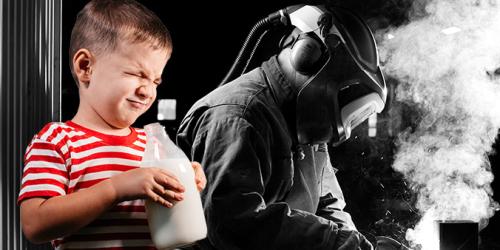

Exposure standards are still just the beginning
The Practical Guide to Welding Fume Control was first released in 2018 and has quickly become an industry favourite for those wanting to understand how to protect their welders and those who work around welders from welding fume.
Updated constantly and whenever new research or information becomes available, the guide stays on the cutting-edge of welding fume control.
The Practical Guide is based on a simple premise - the health risk posed by welding fume is serious, however, keeping yourself safe can be straightforward. Consequently, it outlines the dangers of welding fume and then gives you actionable and practical guidance based specifically on the welding industry.
The Practical Guide to Welding Fume Control outlines how welding fume exposure standards in Australia and New Zealand ‘do not identify a dividing line between a healthy or unhealthy working environment’1, but simply establish a legal maximum upper limit.
To illustrate this, the guide demonstrates that even when a welder is operating within the Workplace Exposure Standard (WES) for Welding Fume (5 mg/m3, TWA), they can still inhale up to 11 grams of a known and classified carcinogen every year if unprotected.
Therefore, the WES for welding fume (not otherwise classified) cannot be viewed as the be-all and end-all. It is the employer’s legal responsibility to reduce exposure to welding fume to as low as reasonably practicable. This means putting controls in place to reduce and minimise welding fume exposure.
Many of the most common chemicals found within welding fume also have their own respective workplace exposure standards. So, in addition to the WES for ‘welding fume not otherwise classified’, workplaces must also ensure that none of these other WES’s are exceeded.
To put this in perspective, the below table outlines both the exposure limits (as specified by Safe Work Australia) and potential health effects associated with the most common chemicals workers may be exposed to when welding:
| Fume Type/ Chemical | Source | Health Effect | TWA (mg/m³) |
| Aluminium |
Aluminium component of some alloys, e.g., nickel chromium, copper, steel, magnesium, brass and filler materials. |
Respiratory irritant. | 5 |
| Beryllium | Hardening agent found in copper, magnesium, aluminium alloys and electrical contacts. |
"Metal Fume Fever." A carcinogen. Other chronic effects include damage to the respiratory tract. | 0.002 |
| Cadmium | Stainless steel containing cadmium or plated materials, zinc alloy. |
Irritation of respiratory system, sore and dry throat, chest pain and breathing difficulty. Chronic effects include kidney damage and emphysema. Suspected carcinogen. |
0.01 |
| Chromium | Most stainless steel and high-alloy materials, welding rods. Also used as plating material. | Increased risk of lung cancer. Some individuals may develop skin irritation. Some forms are carcinogens (hexavalent chromium). | 0.5 or 0.05 (Depending on chemical form) |
| Copper | Alloys such as nickel-copper, brass, bronze. Also some welding rods. |
Acute effects include irritation of the eyes, nose and throat, nausea and "Metal Fume Fever". |
0.2 |
| Iron Oxides | The major contaminant in all iron or steel welding processes. | Siderosis - a benign form of lung disease caused by particles deposited in the lungs. Acute symptoms include irritation of the nose and lungs. Tends to clear up when exposure stops. |
5 |
| Lead | Solder, brass and bronze alloys, primer/coating on steels. |
Chronic effects to nervous system, kidneys, digestive system and mental capacity. Can cause lead poisoning. Ototoxic and therefore risk of hearing loss. |
0.05 |
| Manganese | Most welding processes, especially high tensile steels. |
"Metal Fume Fever." Chronic effects may include central nervous system problems. Ototoxic and therefore risk of hearing loss. |
1 |
| Zinc Oxides | Galvanized and painted metal. | Metal Fume Fever. | 5 |
A changing stance on welding fume
Australian and New Zealand companies are now completely changing their stance on welding fume and welding fume product controls. This began with the 2017 reclassification of welding fumes as carcinogenic, which prompted many to rethink and challenge what they had previously considered as ‘normal.’
Later studies then concluded welders have a ‘43% increased risk of lung cancer’ regardless of the type of steel they weld, the welding process they use and the length of time they are welding for.2
The above research identified the problem, a more recent Australian study has now given workplaces actionable information on the effectiveness of the most common welding fume product controls, or in other words, how to solve the problem.
Information and studies like these should act as a catalyst for workplaces to introduce suitable welding fume controls and provide their workers with the protection they deserve.
Download your FREE Practical Guide to Welding Fume Control here
1 Guidance on the interpretation of workplace exposure standards for airborne contaminants, Safe Work Australia, April 2013
2 2019 Honaryar MK, Lunn RM, Luce D, et al. Occup Environ Med