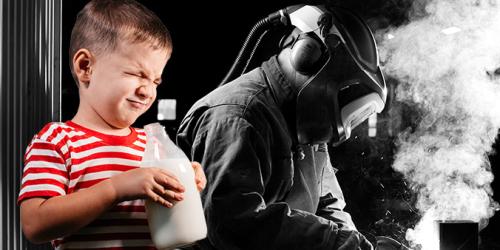

Ozone (O3) is an extremely toxic gas generated when UV radiation from a welding arc reacts with oxygen in the air. Undetectable to the human eye, ozone can cause serious health issues to unprotected welders.
For this reason, in both Australia and New Zealand, a Peak Limitation of 0.1ppm has been established as the Workplace Exposure Standard (WES) for ozone. This simply means that by law, exposure to ozone must at no time exceed 0.1 parts, per million parts of air.
The results of an all-new scientific study have just been released, with the study measuring welder’s exposure to ozone and the effectiveness of different product controls in minimising exposure.
Download the Protecting the Welder from Ozone White Paper here
NEW Australian Study: Protecting the Welder from Ozone
The main objective of this study was to understand the levels of ozone that an unprotected welder may be exposed to across a variety of common welding processes, and to determine whether a Welding Helmet with a Powered Air Purifying Respirator (PAPR) was an effective control in protecting the welder from exposure to ozone.
The results of this study can be used to help employers fulfil their legal duty as it relates to:
- Not exceeding the Workplace Exposure Standard for ozone.
- Reducing ozone exposure to as low as reasonably practicable.
Download the Protecting the Welder from Ozone White Paper here
Talk to a Welding Fume and Ozone specialist
Key outcomes: After reading this white paper
- Understand whether welders can be exposed to levels of Ozone above the Workplace Exposure Standard.
- Determine whether a Welding Helmet with PAPR is an effective control to reduce exposure to ozone.
- Establish whether ozone is an issue for applications that generate low amounts of welding fume.
- Clarify if ozone is a problem for those who don’t weld for long.
- Understand the risk of ozone exposure for surrounding workers.
- Discover the differences between common forms of welding fume product controls in their effectiveness in reducing exposure to ozone.
Talk to a Welding Fume and Ozone specialist
Do you need advice?
The results of this study can be used to help employers fulfil their legal responsibilities as it relates to ozone and welding fume exposure.
For workplaces wanting to reduce the welder’s exposure to ozone and welding fume to as low as reasonably practicable, please contact one of our welding fume and ozone specialists.
Download the Ozone White Paper here
Talk to a Welding Fume and Ozone specialist