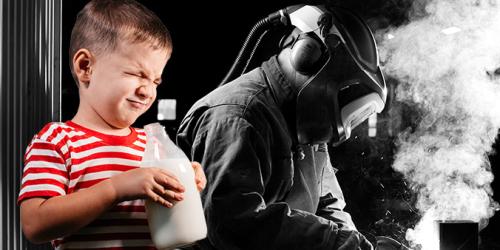
In 2017, the International Agency for Research on Cancer reclassified welding fume as a group 1 carcinogen: the same group as Asbestos and Silica. However, in Australia, the exposure standard for Welding Fume has remained unchanged since 1991.
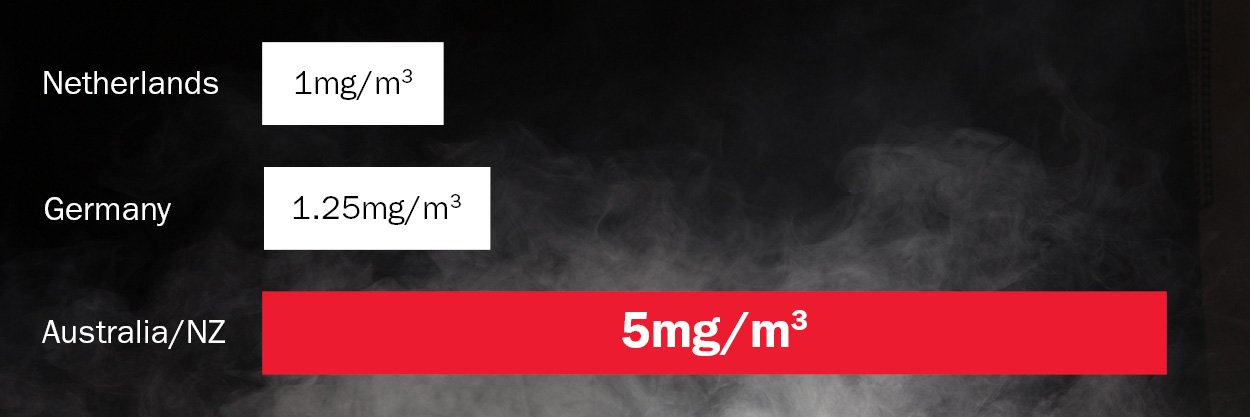
The Australian Manufacturing Workers' Union (AMWU) is leading a huge push on behalf of the welding industry for the exposure standard for welding fume to be lowered from 5mg/m3 to 1mg/m3.
If successful, this would bring Australia’s exposure standards more closely in line with countries like the Netherlands and Germany (see below):
So what does this mean?
Currently, the Safe Work Australia workplace exposure standard for welding fume is 5mg/m3. This means that the maximum average airborne concentration of welding fume inhaled by a worker when calculated over an 8-hour working day, over a five-day working week, must not exceed 5 milligrams of welding fume per cubic metre of air.
The AMWU is proposing that considering everything we now know about welding fume being a carcinogen and welders running a significantly higher risk of developing cancer, that this exposure standard is reduced to 1mg/m3.
“The incidence of cancer is usually dose related” meaning that “the greater the exposure to the carcinogen, the higher the risk of developing the cancer associated with that substance or mixture. Conversely, the smaller the exposure, the lower the probability of developing cancer” [1].
Therefore, a move to 1mg/m3 would send a message to the industry that welding fume is serious, and that action is required.
What can be done to control welding fume exposure?
In 2022, AWS commissioned an Independent Scientific Study to compare the effectiveness of different welding fume product control methods in minimising exposure to welding fume [2]. This study was peer reviewed and published in the Safety Journal in 2023.
Based on the results of the study, AWS have launched a Welding Fume Product Control Selector to help take guesswork out of the equation when choosing solutions to reduce welding fume exposure in the workplace.
So if you’re looking for guidance on welding fume product controls for your specific environment and application, try the product selector tool via the link below!
Try the NEW Welding Fume Product Control Selector here
Download the White Paper on the Independent Scientific Study here
References
[1] Guidance on the interpretation of workplace exposure standards for airborne contaminants, Safe Work Australia, April 2013
[2] 2023 Peter Knott, Georgia Csorba, Dustin Bennett, Ryan Kift. Welding fume; a comparison study of industry used control methods. Safety Journal.