
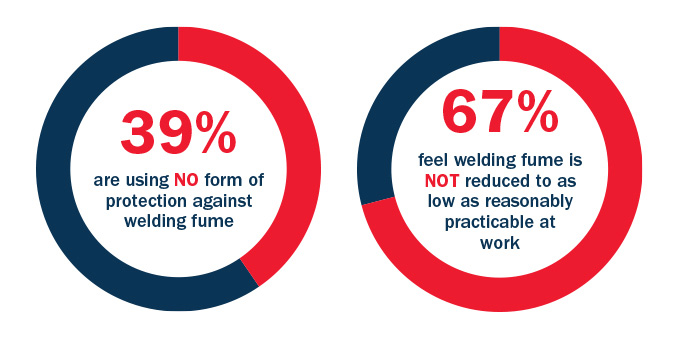
Based on a recent survey (June 2023) conducted by AWS, 39% of welders in Australia and New Zealand are still using no form of protection from welding fume and 67% feel that welding fume is not reduced to as low as reasonably practicable at their workplace [1].
In short, even with all the known risks associated with welding fume, it appears tens of thousands of welders, over one-third of the welding industry, are still being exposed to a group 1 carcinogen with no protection.
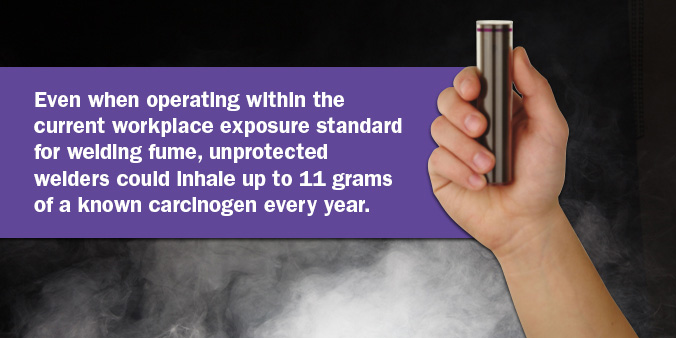
Moreover, based on the typical respiratory rate of 20 litres of air per minute or 2,300m3 of air per year, a welder operating within the current workplace exposure standards for general welding fume (5mg/m3), and wearing no respiratory protection could inhale up to 11 grams of welding fume per year.
So, year on year, an unprotected welder operating within the current workplace exposure limits can potentially inhale 11 grams of a known and identified carcinogen.
A reduction to the exposure standard would mean that many employers would have a legal obligation to ensure that welders’ exposure to welding fume is significantly reduced.
By employing the right combination of controls, welding fume exposure can be minimised to not just 1mg/m3 but well below this level.
Controlling welding fume exposure in your workplace
In 2022, AWS commissioned an Independent Scientific Study to compare the effectiveness of different welding fume product control methods in reducing exposure to welding fume. This study was peer reviewed and published in the Safety Journal in 2023.
Based on the results of the study, AWS have launched a Welding Fume Product Control Selector to help welders and employers understand which controls can be introduced in their workplace to have the greatest effect in minimising welding fume exposure.
Try the NEW Welding Fume Product Control Selector here
Download the Welding Fume Controls Scientific Study White Paper here
References
[1] Welding Fume Product Controls Survey, AWS, June 2023 (560 respondents)