
Powered Air Purifying Respirators (PAPR)
Welding Fume Control
Welding Helmets with Powered Air Purifying Respirators
While care must be taken to mitigate risks through elimination, substitution, and procedural controls, if welding is to be done, welding fume will be present. As a result, in the welding industry, we see that the introduction of product controls is an essential step in controlling welding fume exposures in the workplace.
‘Welding helmets with integrated powered air purifying respirators (PAPR) are the most widely used form of respiratory protection amongst welders in Australia and New Zealand’¹ and are mandatory within many businesses. Here we take a look at the 3M™ Speedglas™ Welding Helmet Range with the Adflo™ Powered Air Purifying Respirator (PAPR).

High Protection Factors – Respiratory protection
The 2017 IARC reclassification of welding fume as ‘carcinogenic to humans’ simply confirmed what was already known – welding fume is extremely bad for health and workplaces must protect their workers. Excessive exposure to welding fume can cause multiple types of cancer, including lung, larynx, and urinary tract. ‘Welders present, on average, a 43% increased risk of lung cancer when compared with those who have never welded or been exposed to welding fume’². ‘This increased risk of lung cancer is regardless of the type of steel welded, the welding process and independent of exposure to smoking’². Precedent for workers’ compensation based on a link between welding fume and cancer was established in the Australian courts back in 2014, opening the door for future compensation claims.
In 2022, an Australian independent scientific study concluded that a Welding Helmet with an Integrated Powered Air Purifying Respirator was by far the most effective control measure in protecting the welder from welding fume exposure when compared to On-Gun Fume Extraction and Fixed LEV Hood Capture, with a reduction in exposure of at least 99.96%³. This equated to an Effective Protection Factor (EPF) of at least 2,600. Meaning the PAPR in the study could reduce welding fume exposure to at least 1/2600th of the outside concentration. This shows a level of performance at least 52 times better than the required minimum protection factor of 50 as specified in the Australian and New Zealand standard AS/NZS 1715:2009³. When compared to disposable and reusable half-mask respiratory protection (RMPF = 10), PAPRs provide superior respiratory protection and do not require fit testing or a complete clean-shaven condition (if relevant to the wearer).
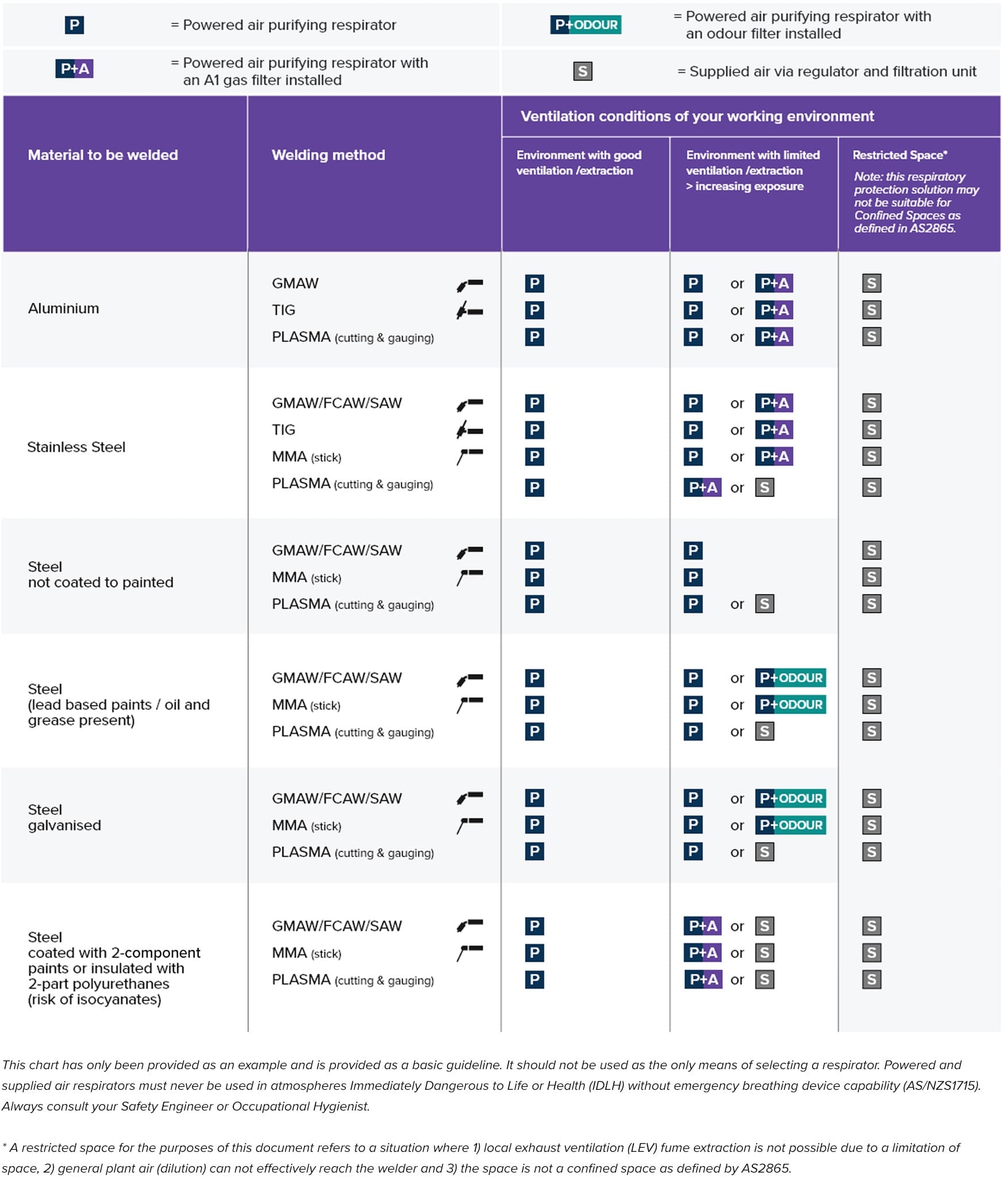
Read the White Paper on this StudyPAPRs can provide protection to welders using the most common materials (aluminium, steel, stainless steel, galvanised steel etc.) and applications (MMA, TIG, GMAW, FCAW, SAW) in environments with good ventilation.
 View the 3M™ Speedglas™ PAPR Range
Integrated Protection – Eye, Face, Hearing and Head
An auto-darkening welding helmet with PAPR can offer up to five levels of integrated protection. In combination with respiratory protection, a welding helmet with PAPR can also offer Eye, Face, Head, and Hearing protection.

Eye Protection: AS/NZS1338.1
Eye injuries account for one quarter of all welding injuries, making them by far the most common injury for welders according to research from the Liberty Mutual Research Institute for Safety. Welding processes generate hazardous ultraviolet and infrared radiation and intense visible light that have the potential to cause permanent eye damage. The purple layer that you see on an auto-darkening welding lens is a UV/IR filter that blocks the harmful components of light, namely, ultraviolet, and infrared radiation. This means that regardless of whether the welding lens is on or off, in the light state or the dark state, welders are always protected from welder’s flash while looking through the welding lens. Intense visible light is then controlled through variable dark shade selection. Physical eye hazards include welding spatter and grinding particles. A recent study conducted within a large manufacturing company with over 1,500 employees, including 600 certified welders, found that ‘foreign body eye injuries decreased over 70% year-on-year in areas that implemented the PAPRs with integrated flip-up auto darkening welding helmets. Worker compensation claims decreased markedly while employee morale increased substantially'⁴. If welders can always see clearly, the need to constantly lift their welding helmet is significantly reduced, meaning they reduce the likelihood of exposure to harmful UV/IR radiation by accidentally striking an arc or being exposed to the arcs of nearby welders and they reduce the potential for foreign body eye injuries from grinding, sparks, or weld spatter.
Face Protection: AS/NZS1337.1 High Impact
All 3M Speedglas welding helmets with PAPR are high impact rated, making them ideal for grinding applications and for protection from potential high speed projectile hazards created by the welder or those around the welders. With a flip-up welding helmet with powered air respiratory protection, welders can have completely clear and uninhibited views of their work piece and surroundings while maintaining their eye, face, and respiratory protection. With a standard non- flip-up welding helmet, if you lift the helmet for clearer views, to inspect their work piece or to move around the workplace, they break their positive pressure respiratory seal. By lifting the welding helmet, they not only allow particles still suspended in the air to enter their breathing zone, they also remove their eye and face protection.
Optional Head and Hearing Protection: AS/NZS1801 & AS/NZS1270
PAPR welding helmets are available with integrated hard hats (safety helmets) and earmuffs to give welders five levels of protection (eye, face, respiratory, head, hearing).
Powered Air Practicality
Fixed and mobile hooded capture Local Exhaust Ventilation (LEV) can protect the welder from welding fume and control the spread of fume throughout the workplace, but neither follow the welder as they move. The powered air respirator goes where the welder goes, allowing unrestricted movement around the workplace with clear vision, comfort, and uninterrupted eye, respiratory, and high impact face protection. Worn on the welder’s back, a PAPR offers continuous mobile protection as welders move around the workplace, making it an incredibly practical welding fume control solution.
View the 3M™ Speedglas™ PAPR Range
Comfort Considerations
A PAPR has several comfort advantages over half mask respirators which is an important safety aspect. The more comfortable a piece of PPE is to wear, the more likely it will be worn correctly. As a half mask respirator becomes increasingly loaded with fume, it becomes harder to breathe through. They can also become hot and sweaty, interfere with the welding helmet, and can give a claustrophobic feel being worn, pulled firmly onto the face. Conversely, a PAPR offers a steady flow of fresh air which can cool the welder down in hot and humid conditions and add to the welder’s comfort level. The PAPR is slim and lightweight and can be worn on the welder’s back (backpack) or across the welder’s waist (belt).

Cost Considerations
The end goal for every workplace should be to lower welding fume exposure to as low as reasonably practicable. For businesses, as low as reasonably practicable will obviously include cost considerations. The per welder cost of a welding helmet with integrated PAPR can be far lower than fixed and portable LEV fume extraction and can be the more economical long-term option when compared to disposable or reusable half mask respirators. Half mask respirators are worn on the welder’s face in closer proximity to the welding plume. As a result, filters can become loaded extremely quickly in certain welding environments. Conversely, a PAPR draws air into the system from behind the welder, away from the greatest concentration of welding fume. For this reason, the filters on a PAPR will typically need to be changed far less frequently than a disposable respirator or reusable respiratory filters. Therefore, in the long run, PAPRs are often the more economical choice when compared to other product control methods.

Productivity Considerations
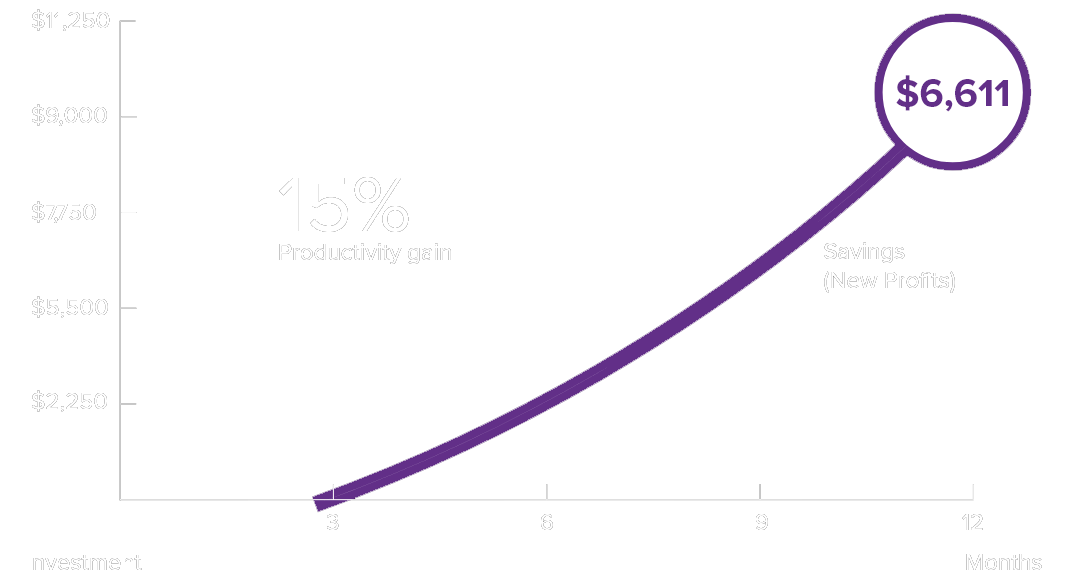
Not only can you weld faster when you can see more clearly, but your entire movement around your workpiece can become more efficient when you’re not constantly having to raise and lower your helmet. We’ve studied welders and their increased efficiency when using our auto-darkening welding helmets for over four decades. Auto-darkening technology with a PAPR can pay for itself within three months: The shorter the weld, the greater the productivity increase. Not surprisingly, applications requiring lots of tack welds have the most to gain. Where the final appearance of the weld is critical – for example, on high-value items – reduction in scrap alone (e.g. from bad starts) can quickly pay for our helmets. Since most welders do a combination of tack and longer welds, we use a conservative, generalised productivity gain estimate of 15%. So, for example, if you’re paying a welder $30 per hour, a 3M Speedglas Welding Helmet with the 3M Adflo Powered Air Respirator has the capacity to pay for itself in less than three months. In one year, the productivity gain may be potentially as high as $6,611 in savings per welder.
Sick days, injuries, and compensation
In 2012–13, work-related injury and disease cost the Australian economy $61.8 billion, representing 4.1% of GDP. The average cost per incident was $116,400 per case⁵. From 2019 - 2020 there were a total of 120,355 serious worker compensation claims – “serious” meaning a minimum 5 days’ absence from work⁶. Introducing welding helmets with integrated powered air respiratory protection to your workplace reduces exposure to welding fume which reduces the welder’s risk of lung function abnormalities, including bronchial asthma, chronic obstructive pulmonary disease (COPD), pneumoconiosis and other pulmonary fibrosis, as well as stomach ulcers, kidney damage, nervous system damage, and cancer. These systems can also offer integrated head, face, eye, and hearing protection. The protection afforded by these systems can lead to a reduction in lost workdays due to injury or illness and can help prevent future compensation claims.
Pulling it all together
A PAPR Welding Helmet is an extremely effective, practical, and cost-effective method to protect welders from welding fume.
As one of the most popular respirators of its kind in the world, the award winning Adflo™ Powered Air Purifying Respirator has become synonymous with welders’ respiratory protection. Trust in a brand can’t be built overnight. It takes years to become known and even longer to be trusted. Over 40 years ago, in 1981, the Speedglas brand released the first ever auto-darkening welding helmet and has consistently set the benchmark ever since. Made in Sweden, Speedglas is the brand of choice for professional welders and remains the world’s leading brand of personal protective equipment for welders.
View the 3M™ Speedglas™ PAPR RangeReferences
- 1) 2020 Welding Fume and Respiratory Protection Survey, AWS
- 2) 2019 Honaryar MK, Lunn RM, Luce D, et al. Occup Environ Med
- 3) 2023 Peter Knott, Georgia Csorba, Dustin Bennett, Ryan Kift. Welding fume; a comparison study of industry used control methods. Safety Journal.
- 4) Case study can be provided upon request
- 5) Safe Work Australia
- 6) Key work health and safety statistics Australia 2021